WINTER HOLIDAY LIGHTING AND DECORATIONS
Winter holiday lighting and decorations are allowed during the holiday season.
Lights must not be excessively bright, nor directed towards neighboring homes, and must not be on all night.
Lighting powered by generators, displays that produce audible sounds, rooftop displays, and inflatable holiday figures and objects are not permitted.
Lighting and decorations may be displayed beginning on the day after Thanksgiving and shall be removed by January 6th of the following year.
Fireworks are prohibited in the City of Depoe Bay and in Little Whale Cove
Smoking is not permitted on LWC paths, roads, or common property.
Forest, Cove & Wetland
Western Sword Ferns – These plants are easily identifiable and have been around for a very long time. Fossil records of fern-like plants date back almost 400 million years. Ferns and similar plants were a dominant plant species until about 230 million years ago.
To help preserve the balance of nature in the tide pools, touching or removing marine life is prohibited.
Special care should be taken when visiting the Cove to prevent dogs from running off-leash, swimming in the Cove, or disturbing wildlife in the area.
Hot Topic – Leyland Cypresses
What is a Leyland Cypress, and why have they become a focus for removal in LWC
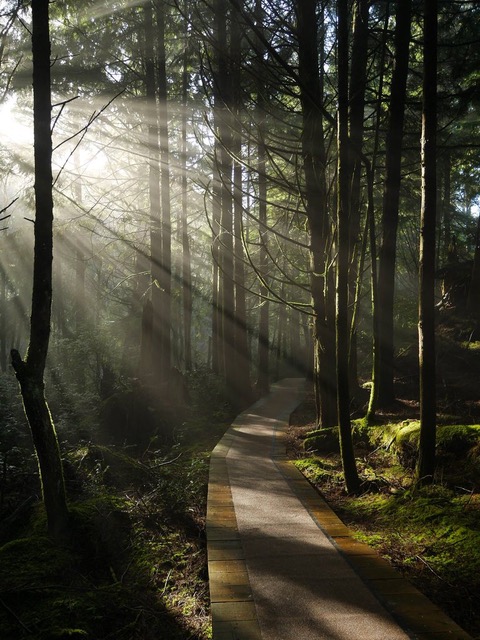
Before we can talk about Leyland Cypresses and why they are of concern, we must understand the makeup of our unique coastal forest, what trees and shrubs they are comprised of, and what they ultimately look like when left to grow on its own.
A true coastal forest goes through an evolution of growth and change where, in the past, old-growth trees shaded out shrubs and smaller trees to create some of the more pristine forest we are familiar with when we go to a State Park or National Forest, for instance.
When land was clear-cut for development, as LWC was, the cycle of growth was altered. All the trees we see now are still in their infancy and fighting to grow and reach more sunlight as the older Sitka Spruce canopies spread out and create more shade.
While it may seem to some that this is a typical forest on the coast, it is still a growing child and very overcrowded. Given time, the many alders and shore pines that took advantage of the sun will start to fall or die back due to a growing habit that focused on its survival by reaching for increasingly more light.
A managed forest would have fewer alders and saplings around older trees that crowd each other and create stressed growing conditions that result in dead growth, limbs, and trees. LWC is too far into its development to address the underlying concerns of the forest as it is now, but what the community staff, along with the Forest Management Committee, can do as required of our due diligence is to identify and address what is not normal and a hazard as it pertains to common areas and, at the same time, educate the community about the importance of the expense and effort.
With all this being said, we can now frame what we do in identifying what is typical and separate this from what has been planted in the past that is not part of our coastal forest environment. More than 25 years ago, the developer, Halvorsen Mason, planted the fast-growing shrubs of Leyland cypresses as beautiful community landscape plants that served many purposes at the time, such as being green, fast-growing privacy barriers. Unfortunately, they did not plan for their natural growing habit when left uncared for, and that is why we have ended up with today’s dilemma and why it is now a hot topic.
Besides having a lifespan of only 25 years, they have now grown to their natural height potential of 40-50 feet. Not only have they shaded out our native trees and shrubs, but they have also created a tinderbox of litter within their canopy that has created the hazard we are trying to mitigate. Our primary focus this year is to address an inventory of soon-to-be-identified ‘trees’ that are on common property and that have the potential to be a fire risk either due to their size, number of dead limbs and litter, proximity to homes, and especially their proximity to CLPUD power stations that are situated throughout the community. In the process, while it may seem that we are advocating for the removal of all Leyland Cypresses, we are only educating along the way and encouraging homeowners to be aware of their landscaped areas and understand that we consider them to be of concern and hopefully address any hazards as they see fit in keeping a fire-safe home.
So, in summary, LWC is not cutting down every Leyland Cypress, but as a non-native competing tree that has serious fire hazard implications, we are targeting the most common ones and also advising as necessary when we come across any tree, whether it be a Leyland or not, if it is a potential risk to a homeowner or the community.
Thanks as always for your engagement in the care and future of LWC and its unique, mostly native forest.